
Star Wars Outlaws in 2026: A Scruffy Scoundrel’s Open-World Caper
Star Wars Outlaws still swaggers into the cantina in 2026 like a scoundrel who knows exactly where the good seats are. Ubisoft’s open-world action game does not twirl a lightsaber or unload flashy Force powers; it slinks into a booth, leaves its holster unbuttoned, and argues that a good blaster at your side is still the more persuasive accessory. That Han Solo-like pitch remains the heart of the experience: a space-western heist story with handsome worlds, a strong sense of adventure, and a scruffy edge that can charitably be called character. Fair enough — not every scoundrel needs a polished cape.
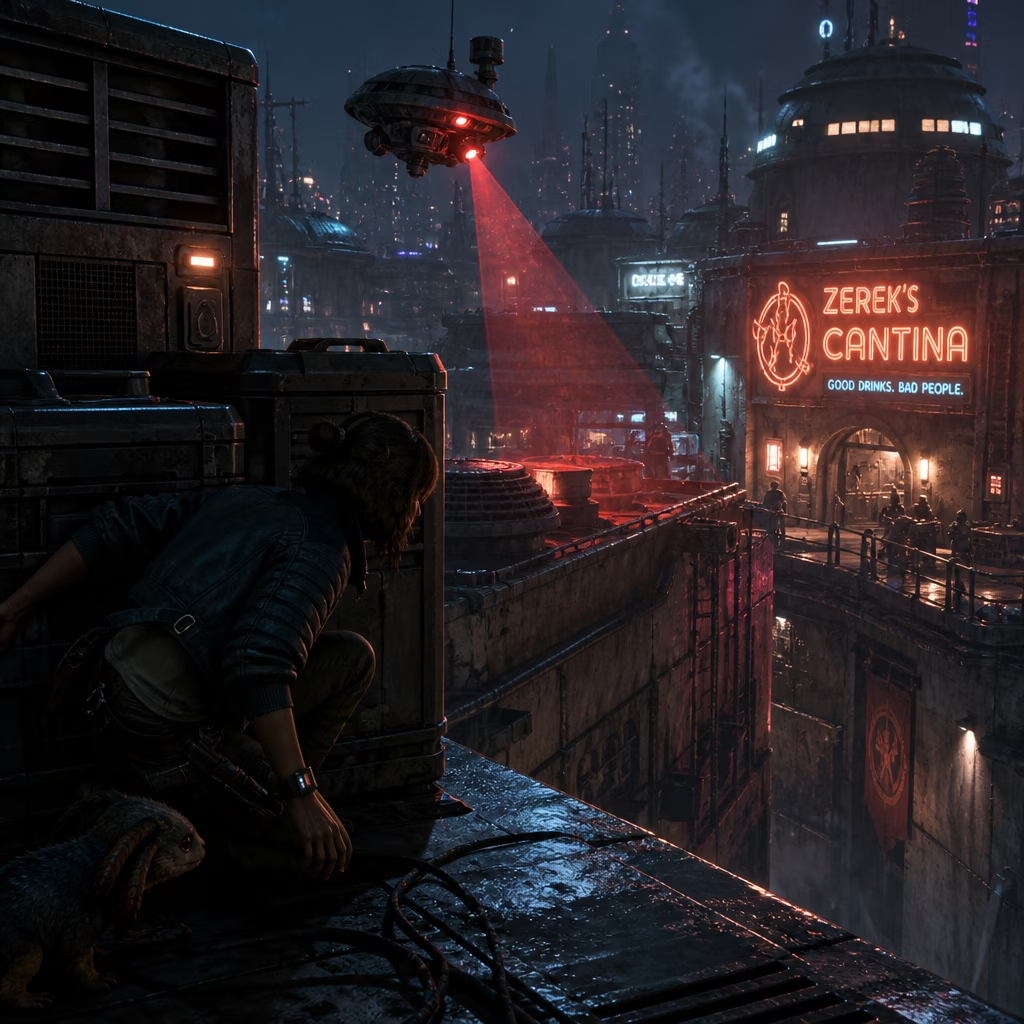
Set between The Empire Strikes Back and Return of the Jedi, the game puts Han literally on ice and hands the battered space boots to Kay Vess, a cunning thief raised in the gambling capital of Canto Bight. Kay is handy with a hairpin lockpick and has an appetite for five-finger discounts, though she never quite steps out of Han’s shadow. Her saving grace is Nix, a pint-sized pet with six fingers sprouting from his furry head and a talent for pinching goods. After an opening vault job goes pear-shaped, the pair crash-lands the stolen Trailblazer on Toshara, an African-savannah-styled planet that mixes beauty with danger. What follows is a roughly 20-hour chain of reckless rescues and underworld deals across four main planets and pirate-riddled space, as Kay tries to unite a crew of like-minded criminals and return to Canto Bight to settle the score and erase the bounty placed on her head by crime boss Sliro.
The story is consistently entertaining, even if Sliro is no Palpatine or Thrawn. The casino owner is intimidating enough, but he stays at a distance and appears mostly in cutscenes. Kay’s journey moves through recognisable spaces, including the impressively recreated dungeons beneath Jabba’s palace on Tatooine, and new ones, such as the hulking High Republic cruiser wreckage on Toshara. The game cuts deals with colourful criminals, including a surly Sullustan mobster on Akiva who issues orders with his feet propped on a desk made from his own carbonite-encased brother. The crime story feels fresh for Star Wars games because it is almost entirely removed from the godlike battles between light and dark. Kay’s profit-driven motives keep her adjacent to the Rebel-Empire conflict rather than swallowed by it. The plot is a Guy Ritchie caper in space, and by the end there are enough shocking crosses and double crosses to resemble the tangle of HDMI cords behind a television. The finale is a rebel-rouser, and Kay’s evolution from self-serving scoundrel to compassionate comrade lands.
The worlds are surprisingly large. This is not No Man’s Skywalker or Starfield Wars; players cannot circle each planet and land wherever they choose. Kijimi is comparatively compact, but the other sandboxes stretch wide and contrast nicely, from Tatooine’s iconic arid sands — rough, and they get everywhere — to Akiva’s lush rainforest, whose rivers become shortcut highways once the speeder bike unlocks the ability to skim across water. The speeder is the only vehicle Kay can steer, despite the landspeeders, dewbacks, and AT-STs visible in bustling settlements. Compared with Grand Theft Auto V or Tears of the Kingdom, the list of usable transportation feels short — shorter than Luke Skywalker in a Stormtrooper suit — though incremental upgrades such as bunny hopping keep it from going stale. No small feat, given how much ground there is to cover.
A Scoundrel’s Toolkit
Outlaws is also about breaking into and out of Imperial bases and syndicate headquarters. Facilities typically offer multiple entry points, from subterranean air vents to high walls reachable with a grappling hook, and binoculars can tag points of interest beforehand. Nix is vital to stealth. He functions like a space cat drone and a Watch Dogs phone rolled into one furry package: he can activate switches while Kay stays in cover, divert security cameras, or claw at guards so Kay can rush in for a surprisingly effective melee takedown. The slicing minigame for cameras and turrets is less intuitive, feeling like a Wordle puzzle in a foreign language, though symbols can be converted to numbers. The rhythm-based lockpicking is far better — a simple game of Simon Says that ranks among the snappiest ways to open doors and crates.
Stealth itself is uneven. Sometimes it is far too easy, allowing the tried-and-tested Assassin’s Creed distract-and-dispatch routine in the same thicket of long grass until unconscious bodies stack up like firewood. At other times it is wildly unpredictable, with alarms triggering during takedowns when no one appears to be around. Combat offers solid cover-based shooting, authentic sounds, and punchy smoke-and-spark effects, but few new ideas. Red barrels seem to arrive on every combat arena’s delivery day, and Adrenaline Rush — a slow-time mark-and-execute move — is effective and satisfying, though it can occasionally pump stylish blaster rounds into cover instead of the chosen target. Kay can permanently carry only her blaster and grenades; dropped weapons such as A300 rifles and Z-6 rotary cannons can be picked up and discarded. The annoyance is how often the game forces a drop: melee, vents, ladders, and walls all strip Kay of her secondary weapon. Who programmed this, RoboCop? Upgrades such as Ion and Power shot modes add flexibility, and in-game challenges replace a traditional skill tree with rewarding bonus objectives, but the system never feels as flexible as the best Far Cry games.
Speeder combat is more restrictive. There is no free aim in the saddle; players dodge blaster bolts while the adrenaline meter charges, then unleash a slow-motion blast. Because enemies are usually behind, the camera can swing too slowly and send Kay crashing into a rock — just like a Scouttrooper on Endor’s forest moon. The unintentional comedy is real, especially when pursuers blaze past a last-second brake and smear themselves against an escarpment. Space combat is more authentic to the films, with dogfights against TIE fighters offering a nice break from planetary skullduggery, though ship modification and cosmic exploration rarely feel essential.
Reputation Has Teeth
The syndicate system is one of Outlaws’ most interesting features. It resembles the reputation system in The Outer Worlds: almost every quest pleases one of four crime families while annoying another. Cosying up to a cartel can mean cheaper prices, but it can also lock down another gang’s headquarters. The system makes quest selection feel meaningful rather than like box-ticking, and it can produce delightfully dirty moments — such as pressuring a store owner into handing over a rare item for free in exchange for a favour Kay has no intention of delivering. This is not Mass Effect; decisions do not drastically alter the ending. They do, however, make Kay feel like a truly rotten scoundrel. Before exploring Tatooine, for example, players may court the Hutt syndicate because Jabba’s goons control large swathes of the map.
Exploration benefits from that freedom. Cantina conversations and discarded datapads point toward treasure, gambling tips, and hidden opportunities in an organic way, making information feel illicit rather than spoon-fed. There is bloat — uninspired checkpoint races and delivery quests — but also strong side missions, including holographic image hunts that lead to lucrative caches. The best quest design spins innocuous objectives into multi-staged adventures, such as a search for an upgrade part that ends with an escape from a sarlacc’s maw and a huge sandworm. Those left-turn stretches are where Outlaws shines, stringing together Star Wars references and Uncharted-style spectacle.
The rough edges remain part of the package. At launch, the PS5 version was plagued by bugs: NPC guns yo-yoing out of hands, guards stuck on or walking through environments, speeder bikes crashing on ramps, a crouch quirk after ledge climbs, black-screen glitches during orbit transitions, unresponsive climbing prompts, confused waypoints, missing mission prompts, a speeder teleporting mid-ride, and dialogue audio dropping out completely. It is hard to eavesdrop when the speaker becomes Tatooine’s least talented mime. In 2026, players should check the current state of updates, but the design identity is clear.
| ✅ What works | ⚠️ What grates |
|---|---|
| Syndicate reputation with real weight | Uneven stealth and repetitive combat |
| Nix as a versatile companion | Constant weapon drops |
| Creative multi-stage side quests | Launch-era technical bugs |
| Strong Star Wars atmosphere | Limited vehicle variety |
Star Wars Outlaws is not a smooth-talking scoundrel. It is a bucket of bolts like the Millennium Falcon: repurposed parts, occasional breakdowns, and a real ability to jolt Star Wars fans into hyperspace. The syndicate system gives weight to choices, Nix adds warmth and utility, and the best quests conjure genuine blindsides. Yet the rigid stealth, familiar combat, and glaring technical issues keep it from ever being the best game in the galaxy. The odds of avoiding every rough edge are, as a famous scoundrel might say, not great. But the game still has enough charm to make the jump.
Recent analysis comes from Game Informer, a long-established source for game reviews and feature coverage, and that perspective fits Star Wars Outlaws well: the game’s appeal lies less in power fantasy and more in atmosphere, faction tension, and the improvisational rhythm of being a small-time outlaw trying to stay one step ahead of both syndicates and the Empire.