
The Contradictions of a Scoundrel: Star Wars Outlaws' Quirky World
In the sprawling digital cosmos of Star Wars, where lightsabers have long cast their dominant glow, a new shadow emerges. By 2026, Ubisoft Massive's Star Wars Outlaws carves out a distinct niche, inviting players into the grimy, morally ambiguous underworld that exists far from the Jedi Temples and Rebel bases. It is a game that succeeds in its core ambition: to let one live the life of a scoundrel, piloting a ship through the neon-drenched ports of Tatooine or the rain-slicked alleys of a Corellian city. Yet, within this meticulously crafted open world, a series of charming, sometimes baffling, contradictions define the experience of being Kay Vess. Her journey is not one of galactic heroism, but of survival, negotiation, and a peculiar set of rules that govern her chaotic existence.
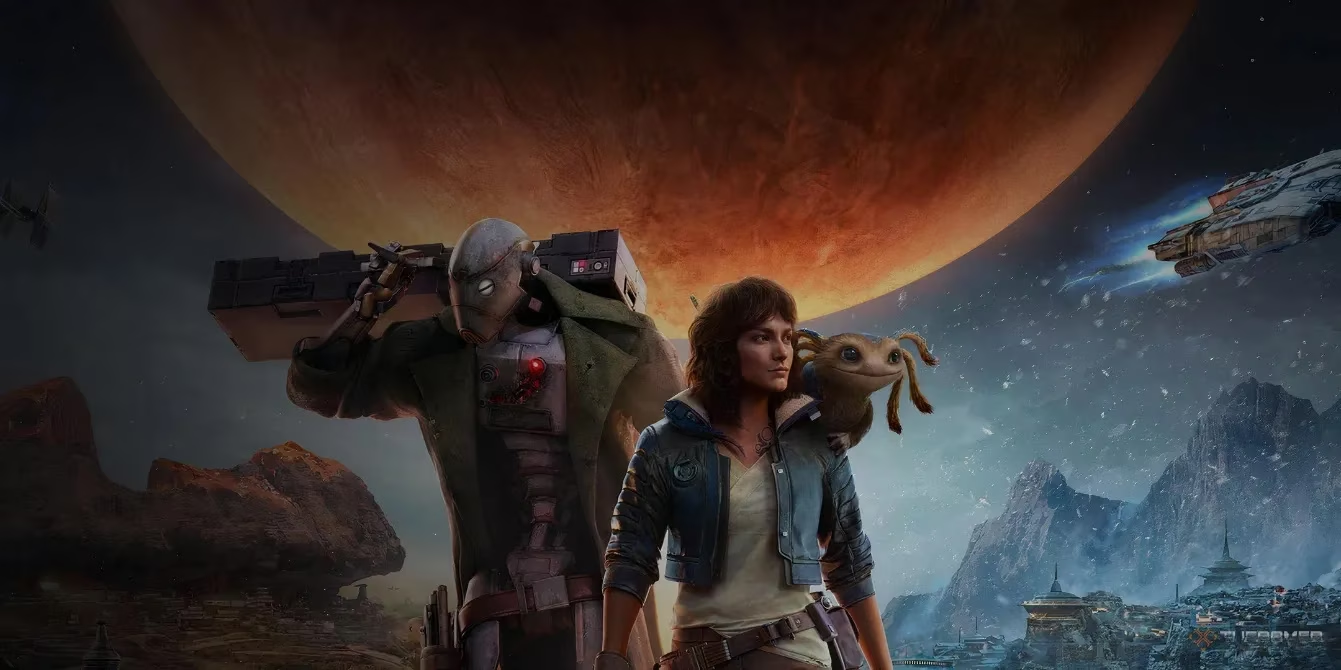
The Phantom Speeder: A Convenient Anomaly
A scoundrel's best friend is reliable transportation, and Kay's speeder is nothing if not reliable—to a supernatural degree. Early in her campaign, she acquires this essential vehicle for traversing vast, open landscapes. It becomes an invaluable asset, a swift escape from Imperial patrols or a quick route to a distant job. However, its summoning mechanic defies the very logic the game works so hard to establish. With a simple call, the speeder materializes directly behind Kay, regardless of location. One moment she is deep within a fortified Imperial compound, having just completed a tense stealth mission; the next, her personal transport winks into existence in the heavily guarded area she just infiltrated. The narrative may painstakingly detail the security of an enemy stronghold, but Kay's speeder operates on a higher, seemingly omniscient plane of convenience, creating moments of delightful absurdity in an otherwise grounded criminal fantasy.
The Case of the Chronic Butterfingers 👐
Kay Vess is established as a proficient thief, a survivor with sharp wits and sharper instincts. She navigates high-stakes heists and outruns authorities with a cool competence. Yet, this aptitude curiously fails to extend to basic object permanence. Throughout her travels, Kay can loot discarded weapons from fallen foes or scavenge caches. However, these items seem to evaporate from her grasp at the slightest provocation. A minor stumble, a quick transition between areas, and the weapon is gone—dropped as if it were a burning coal. This chronic case of butterfingers presents a stark, almost goofy, contrast to her otherwise capable demeanor. Is it a gameplay abstraction? A quirky character trait? Perhaps it speaks to a scoundrel's ruthless pragmatism: tools are discarded the moment they cease to be immediately useful, with no sentimental attachment to material possessions. The result is a Kay who can mastermind a complex robbery but can't seem to keep a hold of a blaster rifle for more than five minutes.
The Empire's Goldfish Memory 🐟
A core pillar of the Outlaws experience is the Wanted system. Commit crimes in plain sight of the Empire—be it theft, trespassing, or open combat—and Kay's notoriety climbs. Stormtroopers give chase, their numbers swelling until the ominous Death Troopers join the hunt. The pressure can be intense, a thrilling cat-and-mouse game across alien cityscapes. Yet, the resolution of this threat often feels perplexingly ephemeral. Kay can be Public Enemy Number One, with half a battalion on her tail, only to have the entire manhunt dissipate after hiding in a vent for a minute or bribing a single corrupt officer. The galactic-spanning Empire, with its vast resources, appears to suffer from institutional amnesia regarding this particular troublemaker. One envisions stormtroopers shrugging, giving up the search, and filing a report that simply reads, "Lost her. Maybe next time." This cyclical dance—intense pursuit followed by complete reset—highlights the friction between narrative consequence and open-world game design, where the player must always be free to engage with the sandbox anew.
The Unbreakable Bond with Crime Lords
Kay's world is a precarious balancing act between three major syndicates: the Pykes, the Hutt Cartel, and Crimson Dawn. Her reputation with each faction fluctuates based on her actions. Kill their enforcers, steal their contraband, and their disapproval mounts, leading to hostile encounters in their territories. However, the system reveals its elastic limits. Remarkably, Kay possesses an incredible amount of leeway with these ruthless crime bosses.
Consider the narrative's pivotal choices: the game presents opportunities for grand betrayals. Kay can promise a valuable artifact to one syndicate, only to secretly deliver it to their rival. Logically, such a double-cross should burn that bridge permanently. Yet, while her reputation meter with the betrayed party drops, the relationship is never truly severed. She can brawl with their thugs one day and be offered a lucrative smuggling job by the same syndicate's lieutenant the next. The crime lords of the galaxy, for all their feared reputations, seem oddly forgiving and perpetually in need of Kay's specific services. It creates a dynamic where her alliances feel transactional and fluid, but never in genuine, narrative-altering jeopardy.
| Syndicate | Typical Reaction to Betrayal | Outlaws Reality |
|---|---|---|
| Pyke Syndicate | Swift, brutal retaliation. | Temporary hostility, then new job offers. |
| Hutt Cartel | A bounty placed on your head. | Reputation decrease, business as usual later. |
| Crimson Dawn | Permanent exile and targeted strikes. | Minor reputation hit, continued interactions. |
The Paradox of a Pacifist Scoundrel 🔫
Perhaps the most defining contradiction of Kay Vess is her relationship with violence. She is a criminal, an outlaw who lives outside Imperial law, yet her moral code draws a firm, uncrossable line: she will not harm neutral civilians. Her blaster is reserved for Imperial forces and syndicate enforcers—those who are, by definition, her enemies. This establishes her not as a psychopath, but as a professional with limits.
This principle makes the moments where she breaks from it in scripted story sequences so jarring. In key cutscenes, Kay will threaten unarmed informants or reluctant allies at gunpoint, her demeanor shifting to one of cold intimidation. This "dark side" stands in direct contrast to the player-controlled Kay, who, in the open world, uses violence primarily in self-defense or as a last resort. It reveals a character capable of ruthless manipulation when the stakes are high enough for the plot, a side of her personality that remains curiously dormant during her day-to-day criminal activities. She is both the thief who won't steal from the poor and the scoundrel who will put a blaster to your head to get a ship part.
In the end, Star Wars Outlaws weaves a compelling tapestry of galactic grift, its successes built upon a willingness to explore the universe's untold stories. Yet, the experience is forever tinged with these peculiar, often humorous, inconsistencies. They are the gaps in the logic of the underworld, the spaces where gameplay convenience meets narrative ambition. They do not break the world but rather give it a distinct, almost personality-driven, texture. Kay Vess navigates a galaxy that is, much like her own character, beautifully detailed, professionally daring, and just a little bit nonsensical. Her story is not one of flawless heroism, but of surviving within a system that is gloriously, hilariously imperfect.