
Whispers of the Outlaw’s Hands
The galaxy hums a tune of dust and starlight, a melody I’ve learned to dance to with a blaster on my hip. In the sprawling, sun-scorched underworld of Star Wars Outlaws, my hands are never truly empty—they cradle a weapon, a tool, a whisper of defiance. The blaster I carry is more than steel and plasma; it’s an extension of my own breath, a constant companion that never leaves my side. Yet, in the heat of a firefight, when the air thickens with danger and the echo of distant explosions, I reach for something else. Something foreign. Something borrowed.
There’s a peculiar magic in grasping a weapon not my own. It’s a fleeting affair, a tryst with power that begins the moment I spot the telltale gleam. Maybe it’s a fallen stormtrooper’s rifle, clattering against the permacrete of a hidden Imperial outpost. Or a heavy repeater, abandoned near a smuggler’s cache, its barrel still warm from a skirmish. The world speaks in subtle cues: a white bar, an icon whispering of potential. I see it hovering above the ground, a silent invitation. Nix, my ever-curious merqaal companion, often scampers ahead, chittering as he retrieves a prize from a downed foe. Together, we weave through chaos, and for a moment, I am not just Kay Vess—I am a whirlwind of borrowed fire.
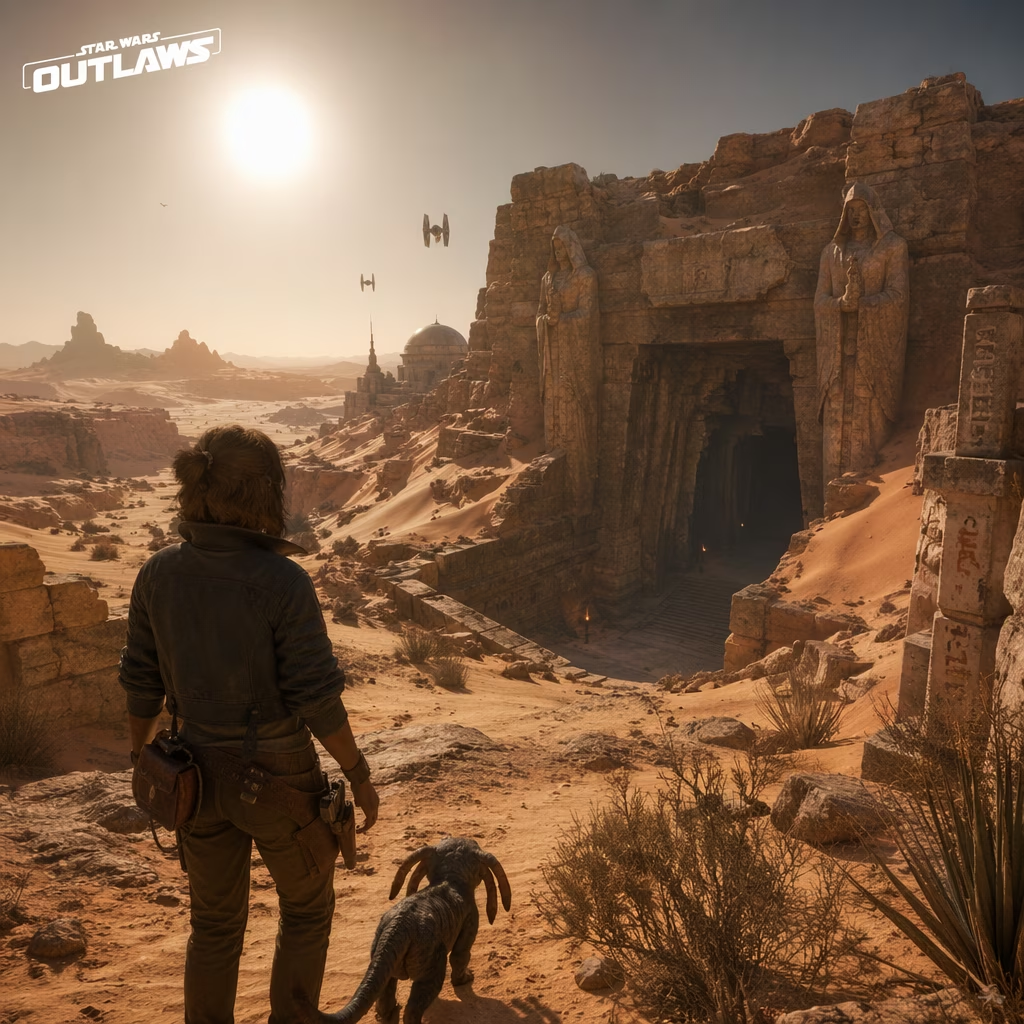
These guns, these strangers in my grasp, abide by their own quiet law. They are generous but fickle, their loyalty measured in ammunition. Around my targeting reticle, white bars shrink like the last grains of sand in an hourglass. Each pull of the trigger drains them, each successful hit a tiny victory against the inevitable. I can feel the weight of the weapon, the unfamiliar kick against my palm, the raw, untamed roar that is not my blaster’s familiar song. The sensation is addictive—a power that urges me to sprint across open ground, dodging blaster bolts with a stolen rifle cradled in my arms. I dash, I roll, I live in those stolen seconds. But the galaxy demands a return to form. The moment I climb a ladder to higher ground, gripping the rungs with sweaty fingers, the weapon clatters away. If I leap to grasp a cliff edge, it slips from my grasp, a sacrifice to gravity. Even mounting my speeder sends it tumbling into the dust, leaving me with only the familiar weight of my own blaster.
My true partner, the blaster I’ve carried since the beginning, does not change appearance, yet it evolves in ways deeper than the eye can see. It transforms through intent, through modules I recover from the hidden corners of Toshara, Kijimi, and beyond. I can make it sing in four distinct voices. The first is Plasma—the classic, searing crimson bolt, reliable and swift, my everyday argument in any debate with syndicate enforcers. Then there’s Ion, a crackling blue kiss that fries droids and disrupts shields, turning mechanical terrors into smoldering scrap. Power shots feel like thunder in my palm, a slower, weightier pulse that punches through armor and sends enemies staggering. And sometimes, in the breath before disaster, I charge a special Stun round—a ring of blue energy that expands from the muzzle, rendering almost any living threat unconscious in a single, merciful pulse. It’s not just a weapon; it’s a spectrum of solutions my fingers know by heart.
Yet, the dance with borrowed weapons remains a thrilling counterpoint. Picture this: I’m deep in a Pyke stronghold, my blaster’s plasma bolts drawing too much attention. An elite guard charges, his heavy blaster cannon spitting green death. Nix darts behind him, a flash of teeth and fur, and the guard stumbles. The cannon drops. I see the white icon shimmer. In a fluid motion born of desperation, I lunge, scoop up the massive weapon, and pivot. The ammo counter flashes full. The world narrows to the firing arc, the rhythm of the stolen cannon erasing corridors of enemies before it runs dry. And then, just as suddenly, the weapon is empty. I discard it without a thought, my hand snapping back to my own blaster. The transition is seamless because it must be. Climbing a ladder to the command center? The cannon falls. Grabbing a zip-line handle? The cannon falls. These fleeting allies demand my total, ground-level commitment.
The emotional arc of a firefight shifts with these pick-ups. There’s the giddy rush of spotting a scoped rifle on a balcony, imagining the clean headshots, the silent take-downs. I’ll crouch, cradling the rifle, and for a few precious minutes, I become a ghost. But I know the spell is temporary. The rifle’s white bars deplete as I fire, and without a steady supply of specialized ammo, it turns into an inert piece of metal. On missions requiring vertical traversal, I’ve learned to weigh the value: do I keep this heavy repeating blaster for the next room, or do I climb to the vantage point, sacrificing firepower for position? Nix often helps me cheat the rules—if I drop a weapon before climbing, he might retrieve it for me at the top, but this trick is fickle, dependent on terrain and the chaos around us. It feels like a small act of loyalty, his little body struggling with a rifle larger than himself, and it makes every successful retrieval a moment of shared triumph.
In the rhythm of outlaw life, I’ve come to see these mechanics not as limitations but as poetry. They are the rules of a song: the blaster is the steady bassline, always present, always grounding. The other weapons are the soaring guitar solos, intense and bright, but finite. Every grenade tossed, every plasma bolt dodged, every weapon picked up and then discarded adds a verse. I’ve grown to appreciate the transient. A weapon held only for a single battle becomes a story, a memory etched into the carbon-scored walls of a cantina or the windswept plains of Akiva.
And so, with a heart tuned to the whisper of distant stars, I continue my journey. Each world offers new instruments for this symphony of survival. A Z-6 rotary cannon torn from a heavy trooper’s grasp. An E-11 sniper with a fractured scope that somehow still finds its mark. They are not mine, but for a few heartbeats, they belong to me. And when they are gone, my blaster remains, a loyal voice in the dark, ready to hum its tune once more. Because the outlaw’s true weapon isn’t the one in her hands—it’s the relentless adaptability she holds within.